
Buying dates by the carton is a different job from picking up a box at the supermarket. Finding a place to buy dates fruit wholesale is the easy part. Knowing what to ask for takes longer, and that is what this guide covers: the varieties, the ripeness words, how bulk packs are made up, what a grade letter means, and how the stock should be kept once it lands in your storeroom. Buah kurma is simply the Malay name for the date fruit.
The useful work in buying dates in bulk happens before you pay. Name the variety, the pack and the grade. Then ask for a sample.
Start with one fact: every date here is imported
Malaysia has no commercial date-growing trade. Every date sold in the country comes in from abroad, so a wholesaler here is an importer or buys from one. That changes the questions you ask. "Where is it from?" has a real answer for each variety, and it should match the box.
Timing matters too. Gulf and Middle-East dates are mostly harvested from late summer to autumn, roughly August to November, and new-season stock reaches Malaysia some weeks later. Demand peaks before and during Ramadan. Hari Raya, weddings (hantaran), kenduri and umrah gifts are the other busy periods. If you plan to sell into Ramadan, order early and confirm stock in writing.
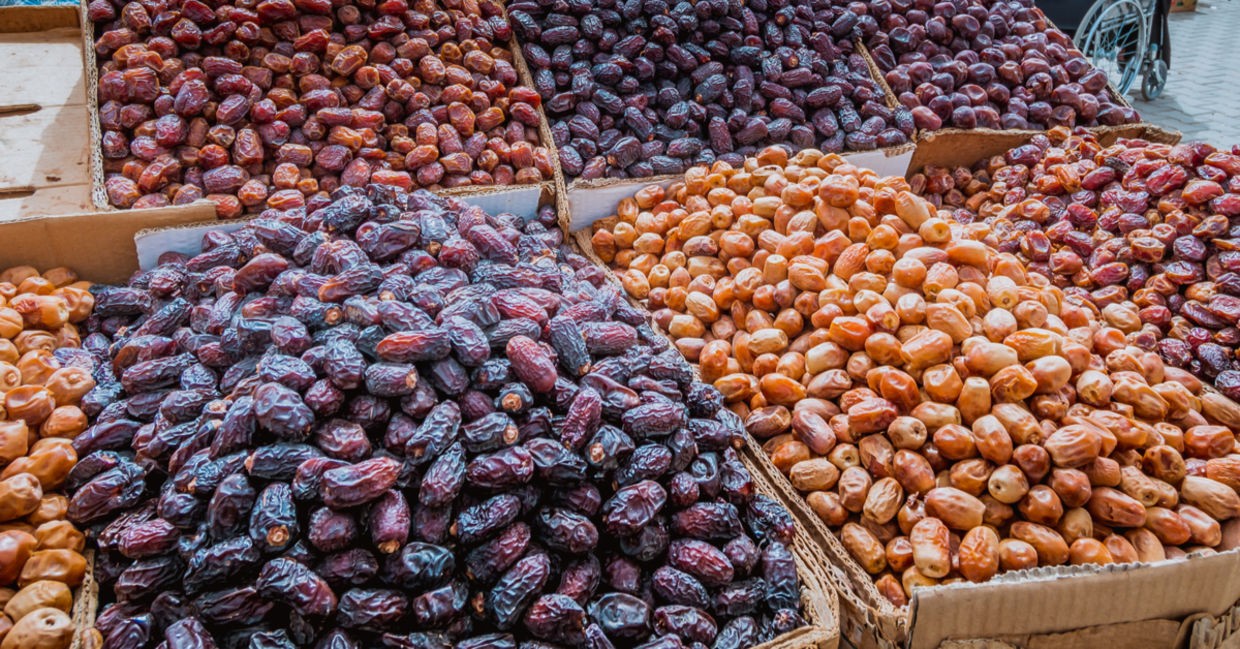
Know the variety you are buying
A wholesale order for buah kurma should name the variety, not just "kurma". The table below lists ten varieties, with the origin and a plain description of each.
| Variety (trade names) | Origin | What it is like |
|---|---|---|
| Ajwa ("Kurma Nabi" is a market name for Ajwa) | Madinah, Saudi Arabia | Small, roundish, near-black, finely wrinkled skin, soft |
| Safawi | Madinah region, Saudi Arabia | Longer than Ajwa, dark brown to black, soft and chewy |
| Mabroom | Madinah region, Saudi Arabia | Long and slender, reddish-brown, semi-dry, chewy |
| Sukari | Al-Qassim, Saudi Arabia | Golden-amber, very sweet; sold soft (rutab) or drier |
| Medjool | Originated in Morocco; check the carton for where your lot was grown | Large, very soft, rich caramel taste |
| Mazafati ("Rotab Mazafati Bam", "kurma madu") | Bam, Kerman province, Iran | Dark, very soft, high moisture; needs refrigeration |
| Mariami | Iran | Dark, semi-dry, chewy |
| Piarom | Iran (Hormozgan) | Dark, semi-dry, thin skin |
| Sayer (also traded as Stamaran) | Iran (Khuzestan) | Amber-brown, semi-dry |
| Deglet Noor ("kurma tangkai" when sold on the stem) | Tunisia / Algeria | Golden, translucent, semi-dry |
A few names are worth checking closely. Mariami and Piarom are two separate varieties, both from Iran. Sayer is not Shahani, which is a different variety. Kurma tangkai is Deglet Noor on its stem, and the stem tells you nothing about Madinah. Mazafati is cold-stored and sold all year, so finding soft rotab in July is normal and not a warning sign.
Rutab or tamar: two ripeness words worth knowing
Rutab (or rotab) is the soft, fresh-ripe stage. Tamr (or tamar) is fully ripe and drier. Many soft varieties, Mazafati among them, are kept in a cold chain, which is why rotab can be bought year-round.
For a wholesale buyer the difference is practical. FAO's date palm handbook says dates in every stage except tamar "are perishable, due to their high water content", and calls the tamar stage "the best condition for storage". The handbook's chapter on harvesting, packinghouse management and marketing says tamar fruit "is used for preservation and year-round consumption". So the stage on the carton matters: FAO treats tamar as the stage that stores best, and the Facts on Mazafati are plain: it needs refrigeration.
Grade letters are the importer's own
A, AA, AAA, Jumbo. These look like a standard, but they are not. Each importer uses its own size sorting, and two suppliers can mean different fruit by "AA". When you compare quotes, compare the same variety and ask each supplier what their grade means: size, how many pieces to a box, how much broken or loose-skinned fruit is allowed. Better still, ask for a sample of the exact grade you would order.
FAO recommends sampling further up the chain as well. FAO's handbook notes that fruit is sometimes stored for up to several months before shipment, and says it is necessary to "sample each consignment, in order to make sure that the quality of the fruit has not changed". A small buyer can apply the same idea: check the first carton of every new delivery, not just the first order.
Bulk packs and retail packs
FAO describes date packing as two kinds, bulk and retail. The table puts the main points side by side.
| Point | Bulk pack | Retail pack |
|---|---|---|
| Usual container | Cardboard box, sometimes with a plastic bag inside for protection and to keep moisture in | Adapted to the retail chain, from its codes to the shelf surface |
| Usual weight | 5 kg or 15 lbs, depending on the producing or selling country | Varies with client demand |
| Who it is for | Customers buying fruit in large quantities | Retail chains ("large networks", in FAO's words) |
| What happens next | May be repacked in the country where it is sold | Carries writing such as the nutritional composition and the last date for sale |
If you run a shop and plan to repack into 500 g or 1 kg tubs, buy the carton and do the repacking yourself, or buy ready retail packs and pay for the packing. FAO adds that bags made of PET are "the cheapest and most economical way of packing", which is worth knowing if you repack.
Whatever you sell, the label matters. FAO notes that in most importing countries the law demands that "data such as weight, country of origin, quality and date of expiry, appear on the package". Check those details on the carton before you accept it, and carry them over to your own packs.
Storing the stock once it arrives
Tamar keeps best, but it still needs care. FAO's handbook says that to store fruit for a long period (several months to one year) it must first be completely cleaned of pests, and that fumigated fruit should not be stored with unfumigated fruit, to avoid re-infestation. It also says that today's market demands fruit with higher moisture content, and that preservation is then ensured by storage under low temperatures.
In practice, keep Mazafati in the fridge or chiller, because it needs refrigeration. Do not mix an old opened carton with a new one.
Questions to settle before the first order
Write them down and get the answers in a message you can keep. Which variety, from which country? What does the grade letter mean in size, and can you send a sample of it? Is it a 5 kg carton or retail packs, and what weight exactly? Is it rutab or tamar, and if it is Mazafati, will it arrive chilled? What is on the label: weight, origin and expiry date?
For a shop owner's view of pack sizes and restocking, see our guide on choosing a dates supplier for a kedai runcit. Traders who prefer to read in Malay can go through the longer panduan buah kurma borong, which covers landed cost and carton sizes. If Medjool is on your list, our Medjool buying notes explain the size grades and pack formats. And for a broader look at what Malaysians buy, read the varieties behind buah kurma in Malaysia.
Short answers
Where do the dates sold in Malaysia come from?
Abroad. Malaysia has no commercial date-growing trade, so every date on sale is imported.
Is a Grade AA carton the same from every supplier?
No. Grades are each importer's own size sorting, not an international standard. Ask for the definition and a sample.
Why is soft rotab available outside the harvest season?
Many soft varieties, Mazafati among them, are kept in a cold chain, so they are sold year-round. That is normal for this kind of date.
What weight is a standard bulk carton?
FAO gives the usual bulk pack weight as 5 kg or 15 lbs, depending on the country where the fruit was produced or will be sold.