
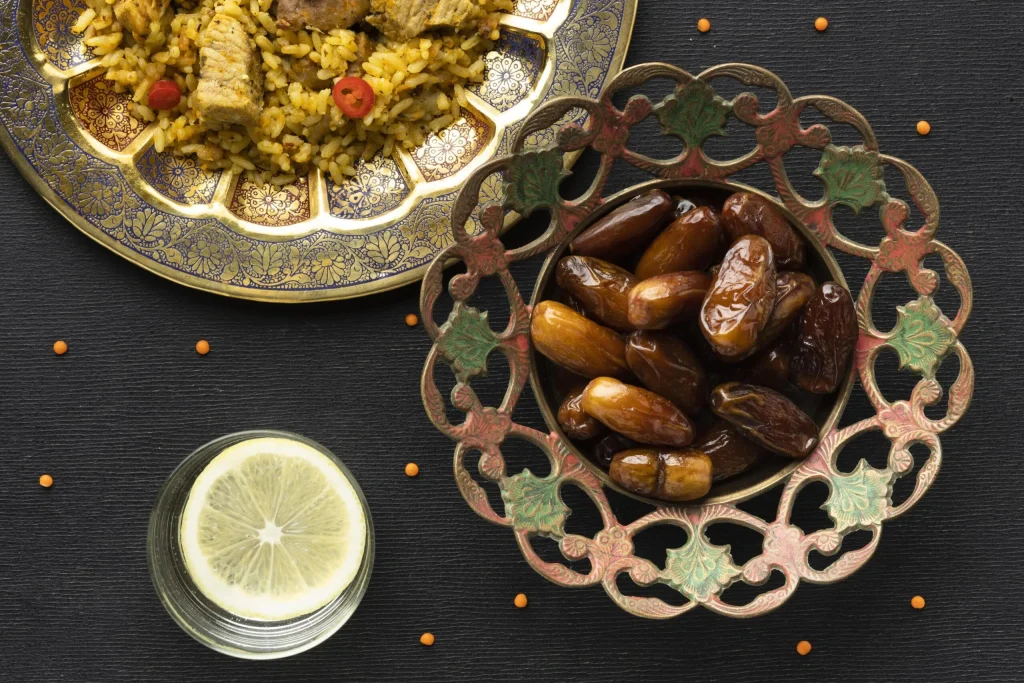
Buah kurma is simply the Malay name for dates. This piece looks at where the sweetness of dates fruit comes from: the palm that grows it, the weeks on the bunch when the sugar builds up, the two kinds of sugar a date can carry, and what happens to that sugar after harvest. The sources are FAO's handbook Date Palm Cultivation (Plant Production and Protection Paper 156), the USDA FoodData Central database and the NHS.
The title says Buah Kurma Malaysia, so one fact first. Malaysia has no commercial date-growing trade, and every date sold in Malaysia is imported. Here, "Malaysian" means the dates people in Malaysia buy and eat. The six varieties described below as sold in Malaysia come from Saudi Arabia, Iran, Palestine (as labelled on the Medjool packs we checked), Tunisia and Algeria.
The palm behind every buah kurma
The date palm's botanical name is Phoenix dactylifera. FAO's handbook gives one explanation of the name: "phoenix" is presumably from a Phoenician name meaning date palm, and "dactylifera" comes from the Greek daktulos, a finger, after the shape of the fruit.
Nobody knows exactly where it started. FAO says the exact origin of the date palm "is considered to be lost in Antiquity", and calls it "probably the most ancient cultivated tree in the world". The varieties on sale today are the product of selection. In FAO's words, date varieties "have been developed by thousands of years of selection of seedlings", and only palms with the qualities growers wanted were propagated. Medjool is the extreme case: FAO says all the Medjool palms in the world originated from one palm in Bou Denib, Morocco.
How a date builds its sugar on the palm
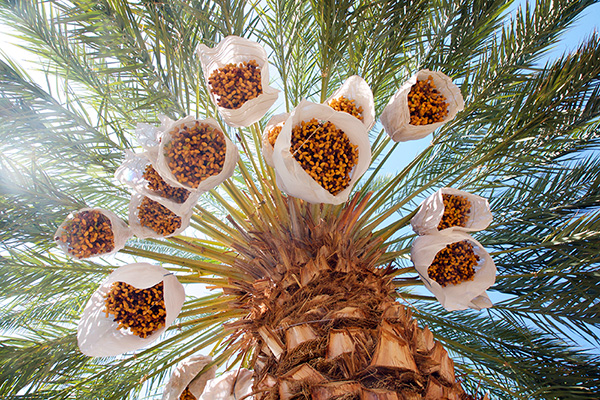
FAO divides a date's growth into five stages: hababouk, kimri, khalal, rutab and tamar. The sweetness story happens in the last three.
By the end of khalal the fruit has reached its full size. It is still hard and has turned yellow, pink, red or scarlet depending on the variety. FAO notes that dates "accumulate most of their sugar, both the sucrose type and the reducing sugar type, as sucrose during the Khalal stage". A few varieties, Barhee, Hallawi, Hayani and Zaghloul, are eaten at this point because they are "very sweet, juicy and fibrous but not sour".
Rutab, which means wet, is when the tip softens and darkens. Two things happen to the taste. As the fruit softens, the last of the tannin under the skin settles out in an insoluble form, so any astringency left over from earlier is gone. And with the exception of a few varieties, FAO says, the fruit at this stage is very sweet. In a reducing-sugar date such as Barhee, the sucrose stored at khalal is inverted during rutab.
Tamar is full ripeness. The date has lost most of its water, and FAO explains that this leaves the sugar-to-water proportion high enough to prevent fermentation. FAO follows this by calling tamar "the best condition for storage".
| Stage | What FAO describes | What it means for sweetness |
|---|---|---|
| Kimri | Hard, apple green | "Not suitable for eating" |
| Khalal | Reaches full size, hard, yellow to red by variety | Most of the sugar is built up, stored as sucrose |
| Rutab | Tip softens and darkens | Astringency gone; very sweet in all but a few varieties |
| Tamar | Fully ripe, dull brown to almost black | Sugar high enough relative to water to prevent fermentation |
Two kinds of sweet: invert sugar and sucrose
Not every date ends up with the same sugar. FAO's chapter on nutritional value says that in most varieties the sugar is "almost entirely of the inverted form (namely glucose and fructose)". The exceptions it names are Deglet Noor and one other variety, in which about half the sugar is cane sugar, or sucrose.
The handbook also reproduces a 1953 study by Cook and Furr of 51 date varieties grown in the USA, sorted into soft, semi-dry and dry types. Total sugars came out close across the three types, averaging 77 to 78% of dry weight. The sucrose share did not. It averaged 1% of dry weight in the soft dates, 17% in the semi-dry and 36% in the dry ones.
USDA FoodData Central lets you see the same split in two varieties sold in Malaysia. Its SR Legacy records for Medjool (FDC 168191) and Deglet Noor (FDC 171726) give these figures per 100 g:
| Per 100 g | Medjool | Deglet Noor |
|---|---|---|
| Total sugars | 66.5 g | 63.4 g |
| Glucose | 33.7 g | 19.9 g |
| Fructose | 32.0 g | 19.6 g |
| Sucrose | 0.53 g | 23.8 g |
| Dietary fibre | 6.7 g | 8.0 g |
| Energy | 277 kcal | 282 kcal |
| Potassium | 696 mg | 656 mg |
Medjool fits FAO's general rule: under 1% of its sugar is sucrose. The USDA record for Deglet Noor dates shows 23.8 g of sucrose in 63.4 g of total sugar, a little over a third. That is less than FAO's "about half", but it puts Deglet Noor clearly in the sucrose camp. These are database averages, not measurements of any pack on a Malaysian shelf.
How buah kurma varieties are described
This section sticks to how each variety is described, not to a measured ranking. Sukari, from Al-Qassim in Saudi Arabia, is golden-amber and very sweet, sold soft as rutab or drier. Medjool, which originated in Morocco, is large and very soft with a rich caramel taste. Mazafati from Bam in Iran is dark, very soft and high in moisture. Ajwa from Madinah is small, near-black and soft. Mariami from Iran is dark, semi-dry and chewy, and Deglet Noor from Tunisia and Algeria is golden, translucent and semi-dry.
Tasting two Buah Kurma Malaysia varieties side by side lets you judge for yourself. One Malaysian wholesaler's list, checked on 22 November 2026, had a 3kg Rotab Sukkary Premium pack at RM63, a 900g Medjool Palestin Jumbo box at RM70 and a 12 × 400g pack of Deglet Noor Bertangkai at RM88, all in stock. Our guide to varieties, origins and textures of buah kurma in Malaysia covers eight varieties in more detail, and the Medjool grade and pack guide goes through the Medjool packs one by one.

Keeping the sweetness after harvest
Sugar can cause trouble after picking too. FAO describes sugar crystallisation, where sugar crystals form on the flesh, and explains that it is caused by broken cell walls or torn skin letting water move inside the fruit or out of it. For Medjool in particular, FAO says crystallising is more common in fruit with a high moisture content at harvest and is an aesthetic defect that puts the fruit in Class II.
Cold helps. For long-term storage, FAO says −18°C is the temperature commonly used for several varieties, Medjool included, because it reduces water loss, sugar crystallisation and skin separation. Deglet Noor is best kept at 0–4°C, and freezing will darken it. Rutab-stage dates turn sour quickly unless they are cold-stored, and Mazafati needs refrigeration.
Cooking with the sugar in dates
FAO's chapter on date products lists several that use the fruit's sugar. Date paste can be used as a filling for cakes. Date syrup, which FAO says is sometimes called dibs or rub, "is used to sweeten various foods". In sauces for steak or chutney, "the dates serve as a source of sugar and to form the body of the sauce".
At home, you can chop a few dates into porridge, a cake batter or a stew in place of some of the sugar. For portions, the NHS counts a 30g portion of dried fruit, "such as currants, dates, sultanas and figs", as one of your 5 A Day, and adds that dried fruit should be eaten at mealtimes, not as a between-meal snack, to reduce the risk of tooth decay. By the USDA figures above, 30 g of Medjool holds about 20 g of sugar.
If you buy in bulk to resell, the buah kurma borong guide covers landed cost and pricing tiers. If the dates are going into a gift instead, our piece on choosing grades and containers for date gifts may help.
Questions about the sweetness of dates
Is the sugar in dates mostly sucrose?
Not in most varieties. FAO says the sugar is almost entirely glucose and fructose, with Deglet Noor and one other variety as the named exceptions.
Why do some Medjool dates have sugar crystals on them?
That is sugar crystallisation. FAO describes it as an aesthetic defect, more common in Medjool fruit with high moisture at harvest, and grades crystallised Medjool as Class II.
Are dates sweeter at rutab or at tamar?
FAO says that, apart from a few varieties, fruit at the rutab stage is very sweet. At tamar the date has lost most of its water, so the sugar is more concentrated relative to water, which is what lets it keep.
Does Malaysia produce its own dates?
Malaysia has no commercial date-growing trade. Every date sold here is imported.
More about this site is on the About Us page and the contact page.